Weekly Photo Challenge: Achievement

Weekly Photo Challenge: Achievement This week, show us a photo that says “achievement” to you: people meeting a long-worked-for goal. Something tangible you’ve created. A view from a journey you’ve completed, or the stating point of a journey not yet made or a project you hope to finish. We look forward to being inspired!

1114achievement

This is not an outstanding photo by any means, but I think it fits the photo challenge for a few reasons.

First, it was taken in Panama. We spent years thinking, planning, and then finally moving here. It is an achievement to successfully move to a different country.

Second, this bridge was under construction for many months. This photo was taken the first time my husband went up on it. The construction of the bridge has been a big achievement, and it has been very interesting to watch the progress from the start (and there is a post with lots more photos in the works).

Third, the bridge is steep enough that it takes some effort to get up there, and it reminds me how well we have done riding our bikes. It is an achievement to improve your fitness and health at any age, but now that we are in our 60’s I am even more proud of our achievements.

Posted in Panama, Photo Challenge, photography | Tagged , , , , | 10 Comments

Making Tamales

I love Panamanian tamales! My friend Cedo thought it was time to make some, brought home a bunch of leaves from her farm, and we picked a day to cook together. I have tried to document the process here, hopefully well enough that you all could make them using these directions.

1. – chicken. I have developed a fondness for the gallinas duras (hard chickens) which are much larger chickens. They are tough and take more cooking but have a wonderful flavor. Any chicken can be used though (or any meat that you prefer).  To save time on tamale day, I cooked the chicken ahead of time.
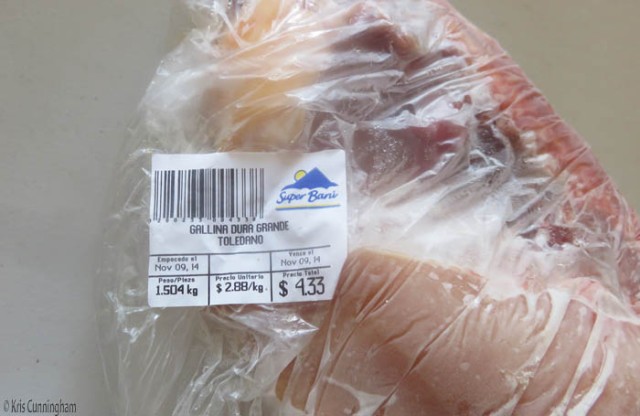
This is half a chicken and is over 6 pounds.

This is half a chicken and it’s over 6 pounds.

A pressure cooker is a very useful thing. I put the chicken in the pressure cooker with about 4 cups of water, a chopped onion, a few sliced cloves of garlic, a couple Maggi bouillon cubes, a few culantro leaves, a handful of chopped peppers (the small ones – sweet, not hot), and a pouch of tomato sauce.

When the chicken was cool enough to handle I took the meat off the bones and put it in the fridge. Then I put the juice or broth in another container and put it in the fridge as well.

2. – corn. Tamales are usually made with maiz seco (dry corn – looks like chicken food. Boil in water until softened and proceed as with fresh corn). I really like maiz nuevo (new corn or fresh corn). It’s a bit more work but I think it is worth it.
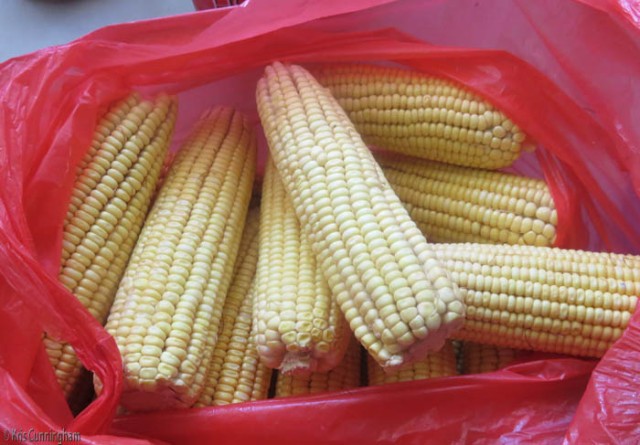
Maiz nuevo - it can be found in most of the little produce markets, but I have found the best deal is to buy it from someone selling it out of their truck. There always seem to be a few trucks by the side of the road the goes north just west of the old McDonalds.

Maiz nuevo – it can be found in most of the little produce markets, but I have found the best deal is to buy it from someone selling it out of their truck ($0.15/ear). There always seem to be a few trucks by the side of the road that goes north just west of the old McDonalds. This looks like the sweet corn in the US but it is not. We don’t have those long days here that it needs to get sweet, but when used in Panamanian cooking I think it is really good.

The sellers will give you corn without the husk, but it is your job to clean off the silk, cut the corn off the cobs, and run it through the grinder. Last time we made tamales, Cedo cooked peppers, onion, and culantro in some oil and then broth, and put that all in the blender. This time though she showed me how to proceed without a blender. Just put the peppers, onion and culantro in the grinder along with the corn. This seemed easier and faster and had great results, so I think I will use this method in the future.

3. Prepare the leaves – The inner wrapping is plantain leaves. They need to be cut to manageable size and boiled to soften them. This is where it is nice to have two people. One can be washing, cutting, and boiling leaves while the other grinds the corn. The plantain leaves are rolled into a bundle and boiled in a pot of water. When one end is soft, turn the bundle other end up to soften the other end. The outer leaves are bijao. They only need to be washed, the stems trimmed, and heated quickly to soften. After the plantain leaves are boiled, that hot water is good for dipping the bijao leaves.

(If leaves are unavailable, tamales can be made in tinfoil packets. The plantain leaves add an interesting flavor though, so use them if you have them. )

4. Put the broth in the ground corn – the broth was retrieved from the fridge and heated on the stove. Cedo is quite efficient in the kitchen and while I was busy grinding, she had the broth ready before I had a chance to watch exactly what she did. I know she flavored it up more with the red sauce and the adobo seasoning and when it passed the taste test, she also added oil (I’m guessing about 1/2 cup). When we made tamales before she added oil until the corn was “brillante” (shiny), and told me this is important to keep it from sticking to the leaves when it is cooked.

5. Prepare the meat and garnish – tamales also contain chicken meat and an attractive garnish of onions, peppers, and tomatoes. The veggies are chopped and sauteed in oil until soft. Before, slices of meat were added separately when the tamales were assembled, but this time shredded chicken was added to the veggies when they were cooked, and all was sauteed together for a minute or two. When we finished this part we realized we had forgotten the tomatoes. We decided at this point we didn’t want to backtrack and the tamales would be fine without them.

6. Assemble and cook tamales – At this point you have your leaves (and some string), your corn filling, and your meat/vegetable garnish. Put a pot or two of water on the stove to boil (depending on how many tamales you are making) and start putting them together.

Put the tamales in the boiling water. After 20-30 minutes when the lower part is no longer green, turn them over so the green part is down in the water. Continue cooking another 10-20 minutes until the wrapping is “chocolate” and there is no more green. Don’t worry about over cooking because that does no harm.

Then, take them out, open one, and eat a tamale!
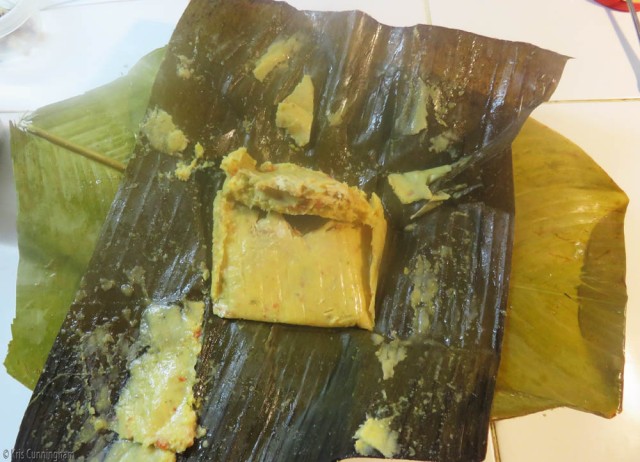
Yeah! The corn that was a bit soupy is now fairly solid and covers the chicken and garnish. But, it is there in the middle.

Yeah! The corn that was a bit soupy is now fairly solid and covers the chicken and garnish. But, it is there in the middle.

Tamales keep well in the fridge for probably up to a week. They can also be frozen. I was told that they come out as good as new when thawed, but none have lasted long enough to get frozen here. Cedo says they should be warmed in hot water, or a covered frying pan with some hot water. The microwave will make them gummy. I warm them in the microwave and they seem to do fine, but I am careful to only heat them as much as necessary and not overheat.

Thank you for bearing with me through this long post. Some people have suggested that a book of Panamanian recipes would be an interesting thing to put together. This is a bit of an attempt in that direction. I see I need measured amounts, an ingredient list, better photos, and I must watch Cedo more closely so I don’t miss any steps. But, Cedo has recipes handed down in her family for generations, she is an experienced cook (had her own restaurant for many years), and in this digital age it can’t be that hard to put together an e-book. So, we shall see.

I am open to suggestions so leave me a comment if you see something that can be improved. If any of you can use these directions to make your own tamales, I will be very excited! (and, of course, happy to “test” your results if possible 😀 )
Posted in food, Panama | Tagged , , | 25 Comments

Los Ramos Says Many Thanks!

An update on what is happening in Los Ramos, Nicaragua, the town worst affected by the mudslides. The people want to say thank you for all the help, and I want to personally thank my friends and blog followers who helped.

Posted in Panama | 1 Comment

The Month of Holidays

People joke that nothing gets done in Panama in November because there are so many holidays! Maybe, but things get done like celebrations, parades, fun, and days off to enjoy.

The month began with Día de Difuntos on Sunday the 2nd. This is a quiet day when people honor the dead, reflect on the loved ones who are no longer with us, and visit cemeteries to leave flowers.

Monday the 3rd is the celebration of independence from Colombia. We have been hearing the marching bands and drums practicing for weeks, and this is the first of the holidays with big parades. I went last year in David and and watched the whole thing, four hours worth! It was great fun to see all the bands, all the young people dressed in their finest, and the very professional marching band performances.

Tuesday the 4th is Flag Day celebrating the flag that first flew in November 1903 after the separation from Columbia. Here is an article with a bit more about the holiday and the flag. On my way back from my morning ride I stopped by the Parque de las Madres which I knew was the starting point of the parade. Young people were lining up, and then bands started playing and baton twirlers twirled and people in traditional dress swirled their skirts and everything started happening as each group rounded the corner to the parade route. What fun!

Wednesday the 5th is is the final day of celebration of the separation from Colombia. It is especially significant in Colón because in 1903, the Panamanian officials there prevented Colombian troops from getting on a train bound for Panama City where they planned to thwart the Panamanian independence.

Monday the 10th is el Grito de La Villa de Los Santos, or the shout in the Villa of Los Santos. The history says that in 1821, a peasant woman in Los Santos was the first to raise her voice for independence from Spain. There are celebrations of this event in Los Santos as well as in other areas of the country. I stopped by the Parque de las Madres in David again to watch the beginnings of this parade. I like it especially because there are oxcarts, traditional dress, and traditional bands and music.


And, there is more! November 28th is independence day from Spain with more parades and celebrations. And, then comes December with Mother’s Day, and then the Christmas and New Year’s holidays. Summer also begins in December with time off from school, various fairs and events around the country, and time for people to relax and enjoy the dry weather. There is no shortage of things to celebrate in Panama!


Posted in culture, Panama | Tagged , , , , , | 9 Comments

Weekly Photo Challenge: Minimalist

Weekly Photo Challenge: Minimalist 

1114minimal1

xx

1114minimal2

xx

1114minimal3

xx

1114minimal4

xx

1114minimal5

Posted in Photo Challenge, photography | Tagged , , , , | 8 Comments

Weekly Photo Challenge: Descent

Weekly Photo challenge: Descent  This week, show us your interpretation of descent — experiment with your point of view and angle, or go even deeper with the theme.

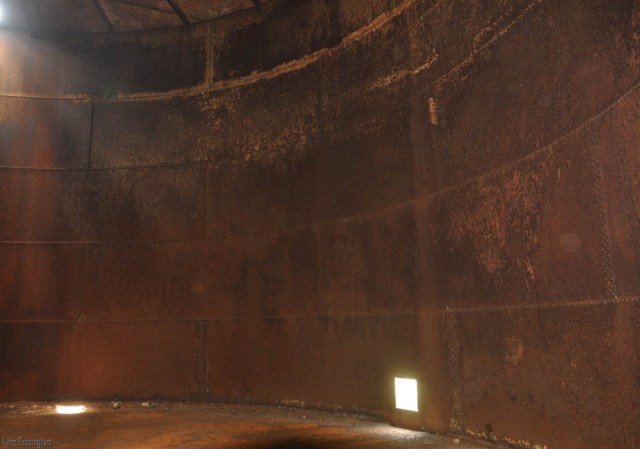
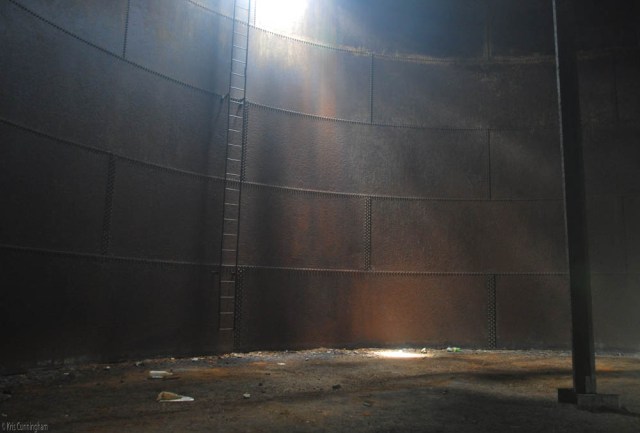
There is an old abandoned water tower in our area, and one day Joel and I crawled in to take some photos. I always meant to go back because it was so interesting but now there are cows in the area. Not knowing how the cows would react (especially if there is a bull among them) I have stayed away. But, I have photos from that first visit so lets descend into the water tower and look around.

1114depth2

xx

1114depth1

xx

1114depth3

Posted in Panama, Photo Challenge, photography | Tagged , , | 8 Comments

The Finca (the Farm) Revisted

It seems like farming should be simple. The cows eat grass, come in to be milked, the milk gets sold, and life is good, right? The more I learn about farming the more I understand how complicated, and how expensive it is.

I hadn’t been to Cedo’s farm for a while, so last Friday we headed up there together. First we had to stop in Conception to pay for the cattle food that would be delivered later. Then we had to stop at Cooleche (the farmer’s cooperative) where she paid what was owed there for various supplies, bought medicine, salt, and minerals which were loaded up into the back of my car.

Recently also, she has had to replace a water heater so the water would be hot enough to disinfect the pipes that carry the milk to the storage tank. Then, something shorted out the electric line that runs to the electric fences so she had to buy wire, and pay and electrician to install it to restore power to the farm. Meanwhile the caretaker was living in the dark and milking by hand. She has had to buy special food and medicine for the calf who had diarrhea and wasn’t doing well. She has had to buy seed and pay someone to plant it to grow more grass for the cows. The vet has to check one of the cows who has a sore foot, probably a stone in the hoof. The list just goes on, and it seems like every week there is something else that needs to be attended to. Don’t even ask how complicated it was to get two 55 gallon drums of molasses filled and delivered to the farm! At least I can help a bit now and then by driving so she doesn’t have to do it all by bus.

So anyway, we arrive at the farm in the late morning.

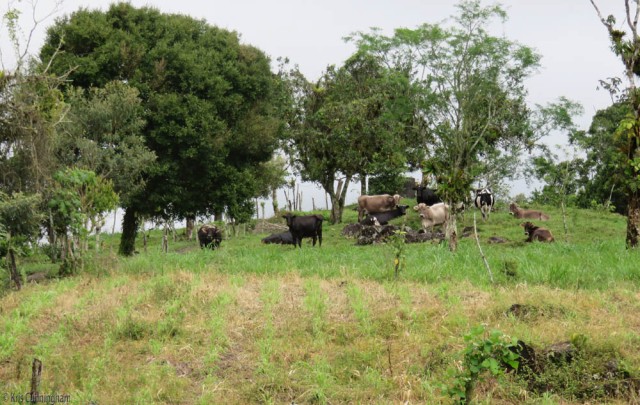
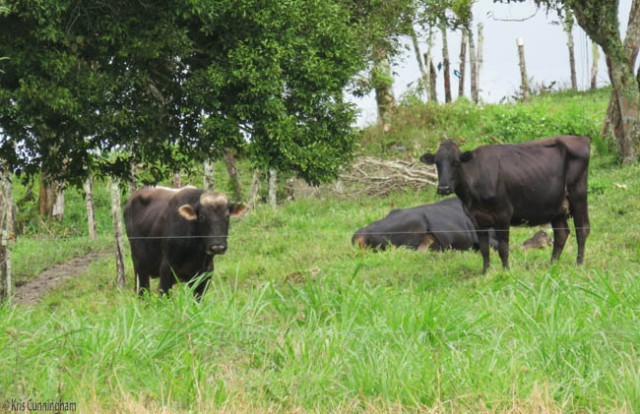
When we arrive, the cows are waiting on the hill for lunch to be served.

When we arrive, the cows are waiting on the hill for lunch to be served.

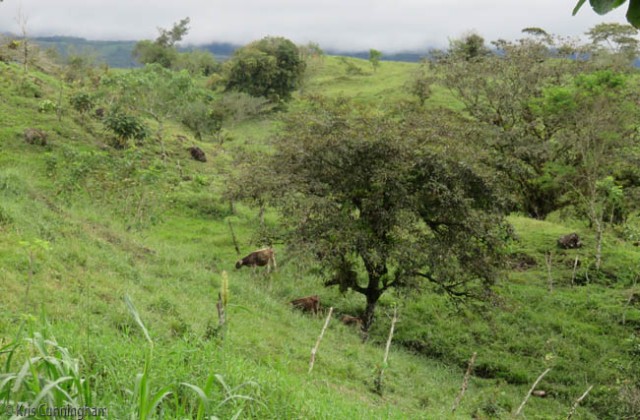
The older calves are grazing down the hill.

The older calves are grazing down the hill.

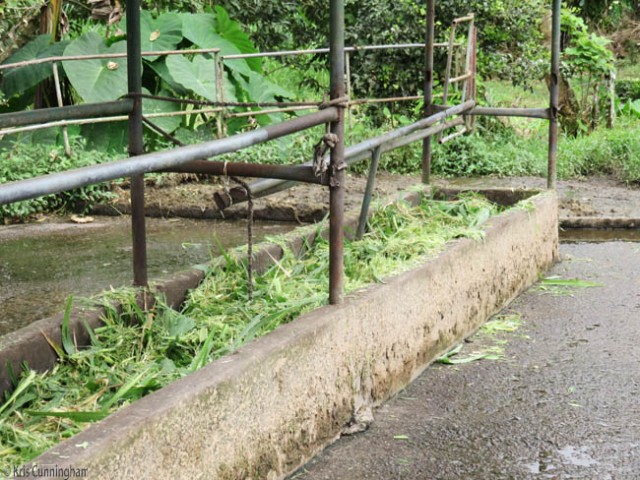
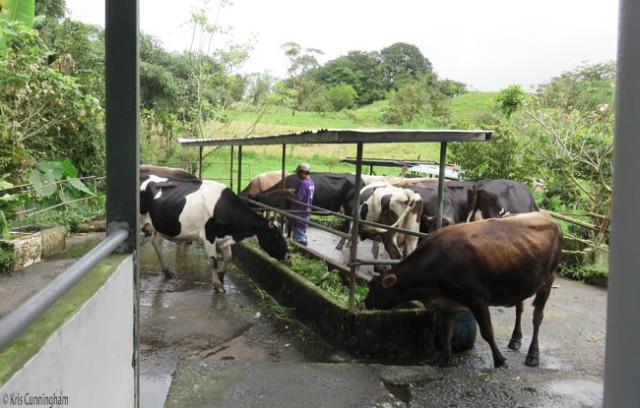
Lunch is served!

Lunch is served!

Every other day the caretaker cuts tall grass for the cows, hauls it back to the milking building, runs it through the chopper, and serves it to them for lunch and dinner. The molasses is diluted with water and sprinkled over the grass. It adds nutrition and since they like the taste, they eat better and produce more milk.

The bull gives us the evil eye.

The bull gives us the evil eye.


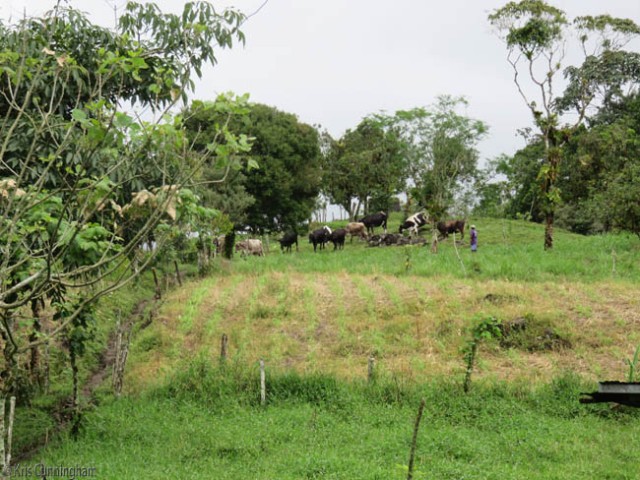
Lunch is ready, so the caretaker goes up to encourage the cows to come down and eat.

Lunch is ready, so the caretaker goes up to bring the cows down to eat.

The bull does not like visitors. Do not touch my women. Do not look at my women. Don’t even think of being on the same farm as my women! This bull apparently has no respect for human women and respect only for a couple guys who he knows, like the caretaker. We are very careful to know where the bull is at all times, and to not go into the pasture where he is. But, to his credit, he has been doing his job and most of the cows are pregnant.

The cows start to eat while the caretaker ties the bull to the railing (behind the black and white cow on the left)

The cows start to eat while the caretaker ties the bull to the railing (behind the black and white cow on the left)

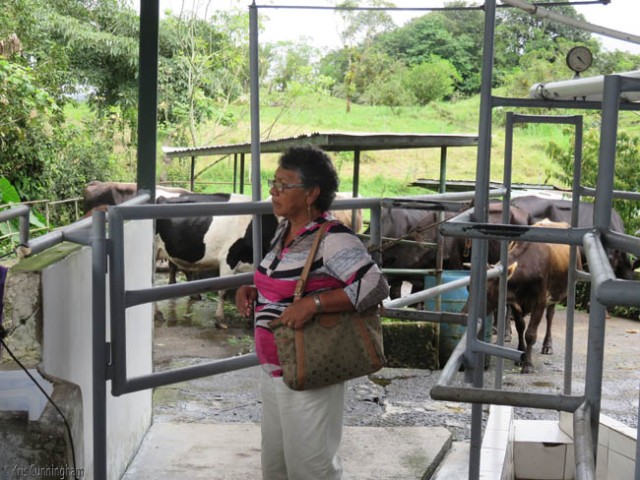
La jefe (the boss) Cedo surverys the scene

La jefe (the boss) Cedo surverys the scene

The farm also has chickens and pigs. In the past it produced vegetables for sale to restaurants, but that would take more work and manpower than is available now. It currently does produce squash, chayote, bananas, plantains, and citrus fruits though, and I am often the recipient of some very nice gifts from the farm.

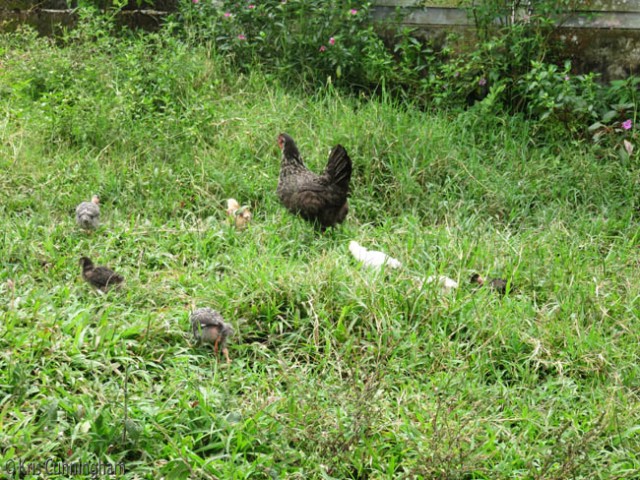
There are baby chicks of various sizes following their mothers, or if bigger exploring on their own.

Baby chicks follow their mother around. There were also some bigger ones out exploring on their own.

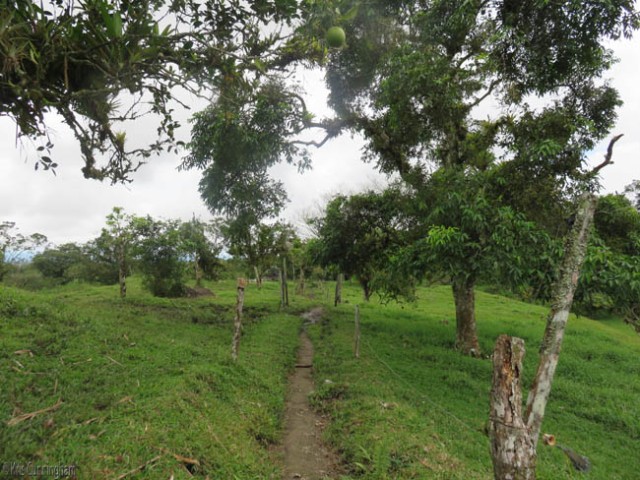
We head up the path up the hill to check on the grass which was recently planted.

We head up the path to check on the grass which was recently planted.

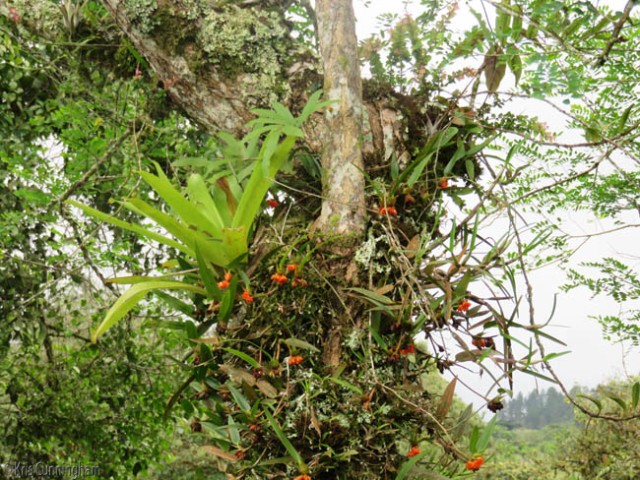
Pretty orchids grow wild in a tree.

Pretty orchids grow wild in a tree.

One of the pasture areas was recently planted with grass for the cows. It is a bit far from the milking and feeding area but Cedo explained that it will be included in the pasture rotation. The cows will be allowed to graze one day, some fertilizer will be applied, the grass will be allowed to grow for a few days, and then the cycle will be repeated.

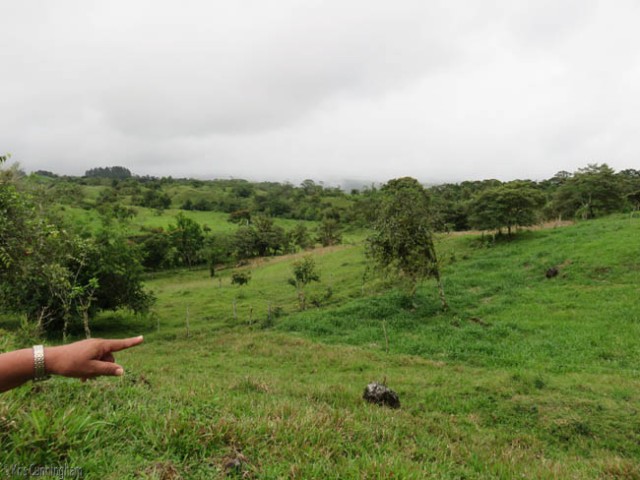
The greener patch of grass that Cedo is pointing to is the newly planted grass.

The greener patch of grass that Cedo is pointing to is the newly planted grass.

Cedo was happy that the grass looks green and healthy.

Cedo was happy that the grass looks green and healthy.

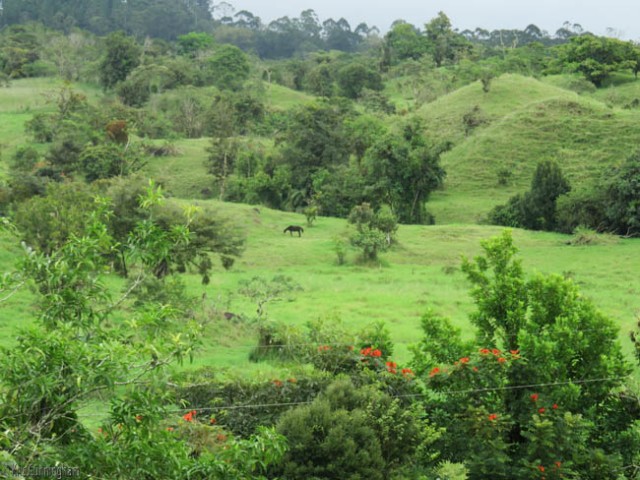
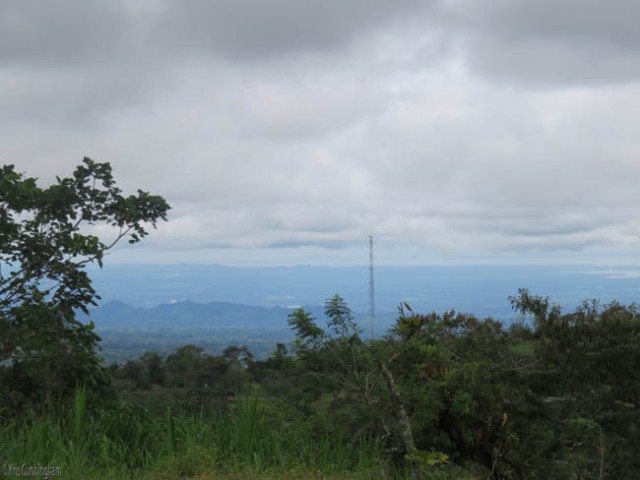
The hills beyond make a very picturesque scene.

The hills beyond make a very picturesque scene.

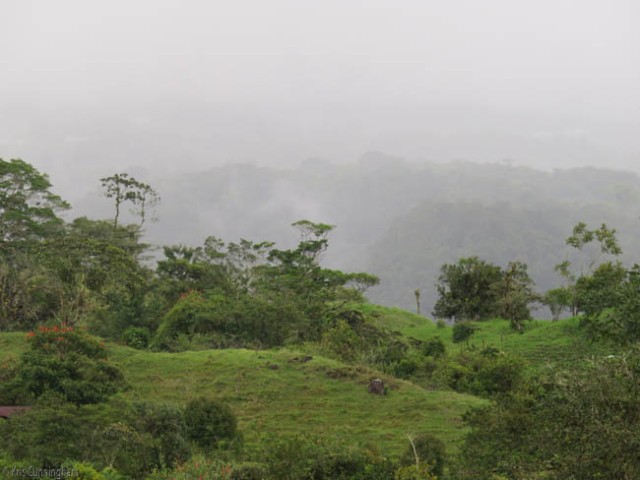
In the distance, it looks like the rain is moving in.

In the distance, it looks like the rain is moving in.

Cedo asked me to take some photos of the corner of the wooded area to remind her about something, maybe checking the condition of the fence?

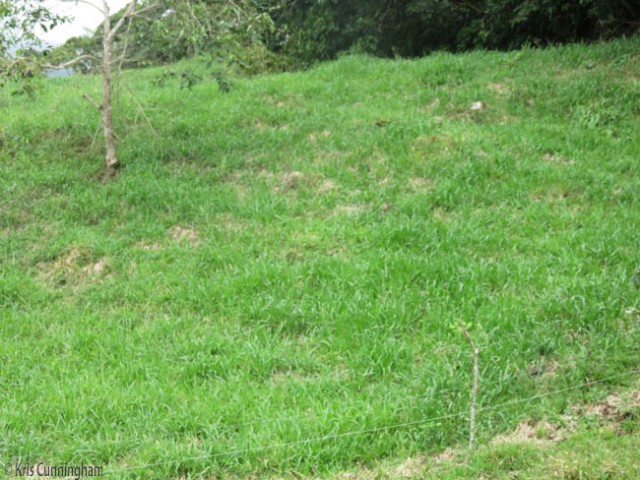
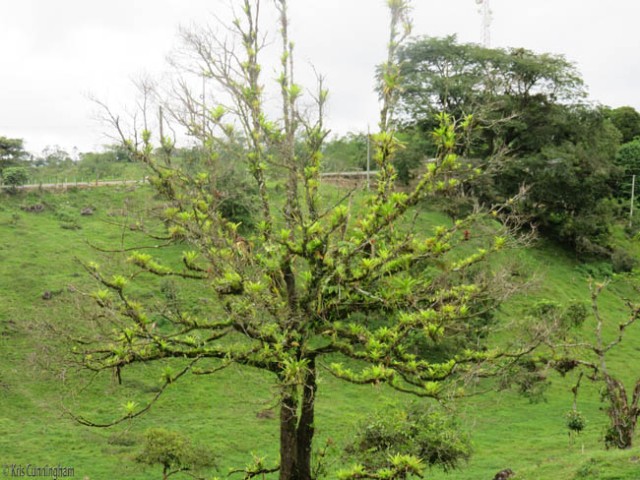
I love how so many of the trees are almost their own forests, covered with a variety of other plants.

This pretty tree caught my eye as we walked back.

This pretty tree caught my eye as we walked back.

In the distance, you can see the Pacific Ocean!

In the distance, you can see the Pacific Ocean!

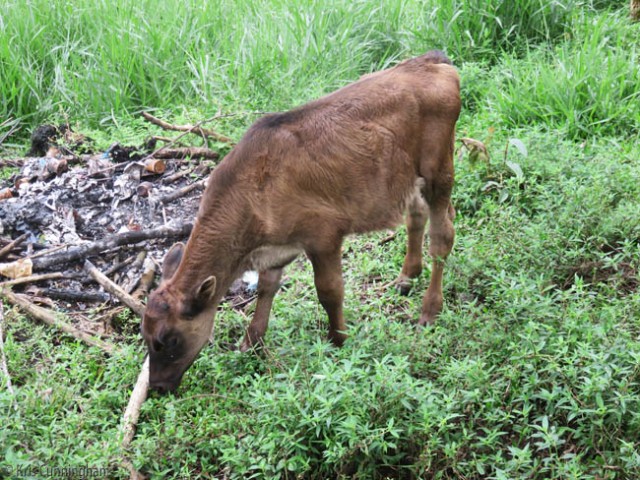
Cedo has had a lot of trouble with calves, and has lost three of the last four ones born. She got this one medicine, special food, and a very specific list of instructions for the caretaker that must be carefully followed. This calf looked like skin and bones when I saw it last, but thankfully she is thriving now and looks so much better!

Cedo says this breed of cattle never looks very plump, and she was very happy with the condition of the calf now. She certainly looked way better than when I had seen her before!

Cedo says this breed of cattle never looks very plump, and she was very happy with the condition of the calf now. She certainly looked way better than when I had seen her before!

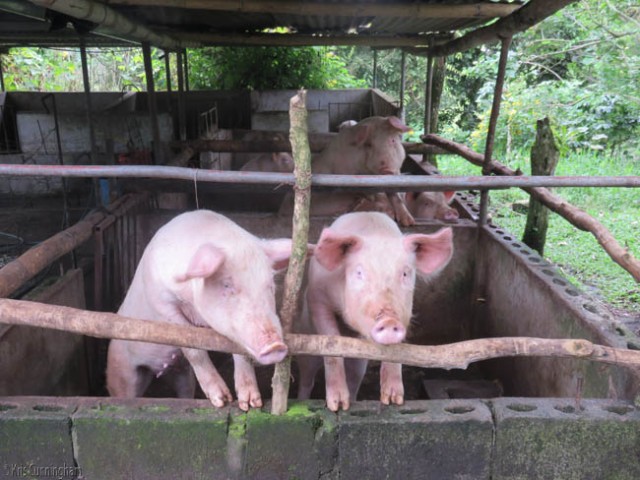
Last, but not least, we visited the pigs who were very excited to have visitors.

Last, but not least, we visited the pigs who were very excited to have visitors.

I don’t know much about farming and taking care of animals, but the more I learn the more I am sure I am not getting involved! It gives one new respect for where your milk, meat, and produce come from. She sells to Nevada, so when you buy milk be sure you buy Nevada and think about all the work that goes into the bottle of milk in your hand.


Posted in culture, Exploring the Area, Panama | Tagged , , , , , , | 14 Comments

Día de Difuntos

Día de Muertos, or Día de Difuntos is the day to remember the dead, and takes place on November 2nd. It is a quiet day with no alcohol sales, loud music, parties, or other festivities. Instead it is a day of respect, quiet reflection, and remembering loved ones. People visit cemeteries, clean the graves, and leave flowers.

I went to Cuesta Piedra the other day with my friend Cedo, and we stopped by the cemetery to visit the grave of her mother. Her mother died very young, at 36, leaving behind a large, fatherless family of 10 children. It was very hard, especially for the older children, but they all made it. Today nine of them are still living, scattered throughout the country but they all talk frequently and stay in close touch.

I snapped a few photos of the cemetery during our visit.


The Day of the Dead is celebrated Latin American countries and many countries throughout the world, though the forms of celebration may vary. Click the link for an interesting Wikipedia article about these various traditions.

Posted in culture, Panama | Tagged , , , | 1 Comment

Weekly Photo Challenge, Cover Art

Weekly Photo Challenge, Cover Art For this week’s Photo Challenge, stimulate your creative process and imagine which of your images you would like to see gracing the cover of a book, an album, or a magazine.

1014cover1

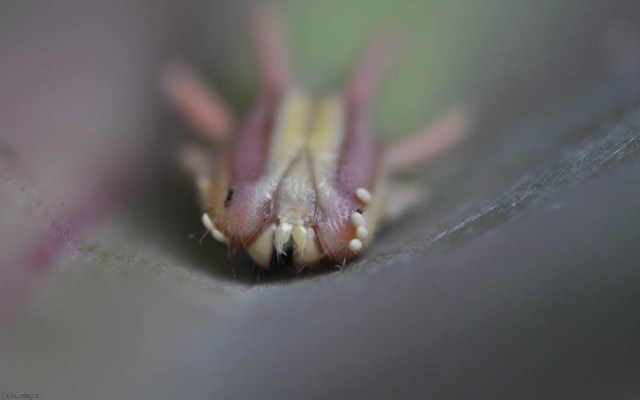
We cut down a banana tree to harvest the bananas, and found this creature under one of the leaves. If my research is correct, it is a caterpillar of the owl butterfly, a beautiful, large butterfly that we see frequently in our yard.

1014cover2

I think the white bits are some sort of pollen. When we discovered him the leaf had been lying in the grass, and we saw these spots on his body and the leaf as well.

Our new friend is now in a large plastic jar on the table. He apparently spend a fair amount of time last night munching on the banana leaf. This morning i gave him some new fresh leaves, and we will see how he does. If he makes a cocoon and morphs into a butterfly, that will be totally cool!

1014cover3


Posted in fruit, gardening, insects, Panama, Photo Challenge, photography, wildlife | Tagged , , , , | 8 Comments

Panama Cost of Living Report – October 2014

What does it cost to live in Panama? The answer can vary widely depending on where and how you live. I can tell you though what it cost us to live in David, Chiriqui, for the month of October.

Fixed expenses Rent $385
Cable (TV/internet) $60.49
Car insurance, monthly (2 cars) $50
Food $395.63
Other Gas for the kitchen (a can lasts at least a month) $5.12
Electricity (it is usually around $40 but we were gone for part of the billing period) $27.07
Gas for the cars $65
Minutes for phone $16.05
Medicine (the Nicaragua bug) $14.49
Optional and/or one time expenses Eating out $44.03
Pricesmart membership (for a year) $37.45
Bike repair $14.75
Car repair $232
Gift $23.53
Pedicure $10
Charitable donation $173.50
Beer / alcohol $98.60

The grand total is $1652.71.  But, this is the first major car repair we have had in almost two years. The charitable donation is optional, of course. And, the total would also be lower if we hadn’t just gone to Pricesmart and stocked up on some food and household items, as well as enough beer/alcohol to last for quite a while.

If you subtract the car repair and charitable donation the total is $1247.21, which I think is a more realistic representation of what we usually spend in a month. Of course this is for basic living expenses. There will always be something additional like the car, travel plans, or something else.

Our biggest expenses are rent and food. We are very fortunate to have found an affordable house in a nice neighborhood of mostly professionals, business owners, teachers, and some retired people. Housing costs will vary greatly depending on where you live.

Food is another variable. We eat mostly local food and buy all our produce from the local markets. We eat very little imported and/or processed food because it is expensive and we don’t like it as well. We also never eat out unless it is a social thing with friends.

If we are home in November I’ll track our expenses again. It is interesting for us also to see what we spend and where.

Posted in cost of living, Panama | Tagged , , , , | 22 Comments