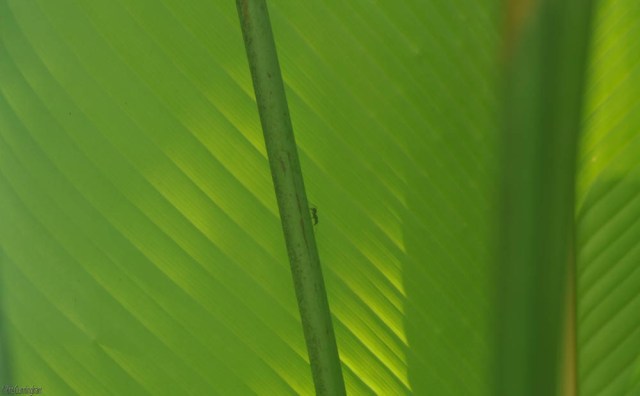
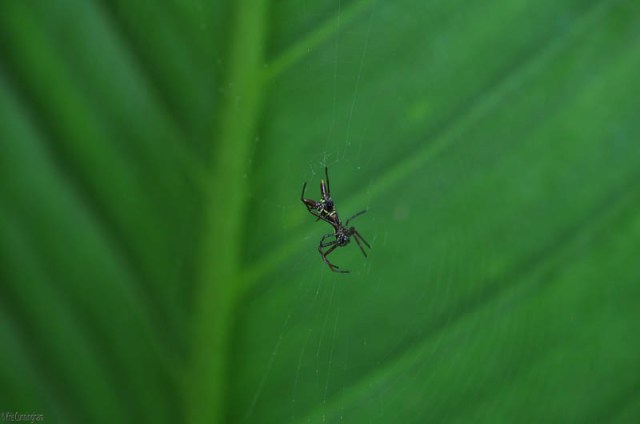
Weekly Photo challenge: DescentThis week, show us your interpretation of descent — experiment with your point of view and angle, or go even deeper with the theme.
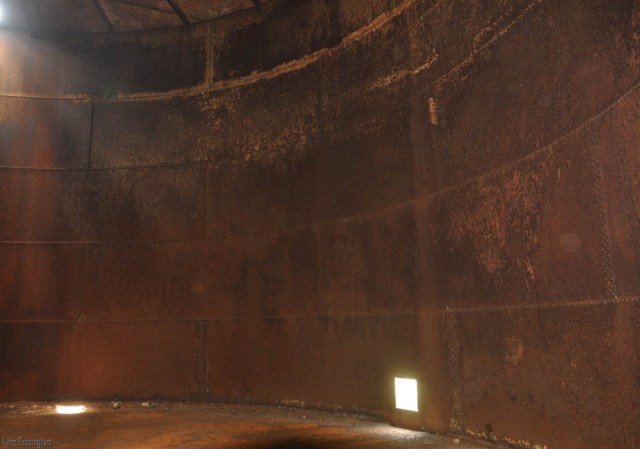
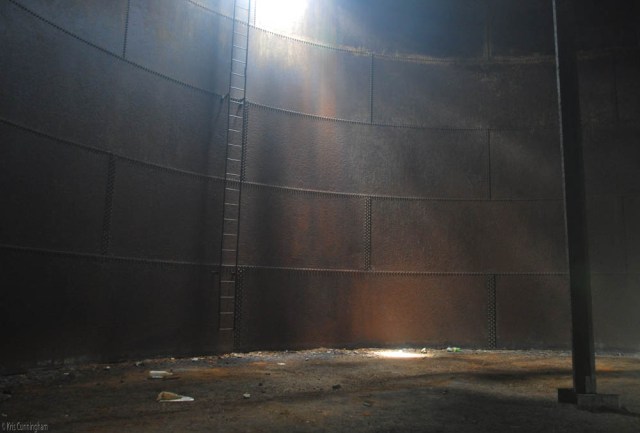
There is an old abandoned water tower in our area, and one day Joel and I crawled in to take some photos. I always meant to go back because it was so interesting but now there are cows in the area. Not knowing how the cows would react (especially if there is a bull among them) I have stayed away. But, I have photos from that first visit so lets descend into the water tower and look around.
It seems like farming should be simple. The cows eat grass, come in to be milked, the milk gets sold, and life is good, right? The more I learn about farming the more I understand how complicated, and how expensive it is.
I hadn’t been to Cedo’s farm for a while, so last Friday we headed up there together. First we had to stop in Conception to pay for the cattle food that would be delivered later. Then we had to stop at Cooleche (the farmer’s cooperative) where she paid what was owed there for various supplies, bought medicine, salt, and minerals which were loaded up into the back of my car.

Recently also, she has had to replace a water heater so the water would be hot enough to disinfect the pipes that carry the milk to the storage tank. Then, something shorted out the electric line that runs to the electric fences so she had to buy wire, and pay and electrician to install it to restore power to the farm. Meanwhile the caretaker was living in the dark and milking by hand. She has had to buy special food and medicine for the calf who had diarrhea and wasn’t doing well. She has had to buy seed and pay someone to plant it to grow more grass for the cows. The vet has to check one of the cows who has a sore foot, probably a stone in the hoof. The list just goes on, and it seems like every week there is something else that needs to be attended to. Don’t even ask how complicated it was to get two 55 gallon drums of molasses filled and delivered to the farm! At least I can help a bit now and then by driving so she doesn’t have to do it all by bus.
So anyway, we arrive at the farm in the late morning.
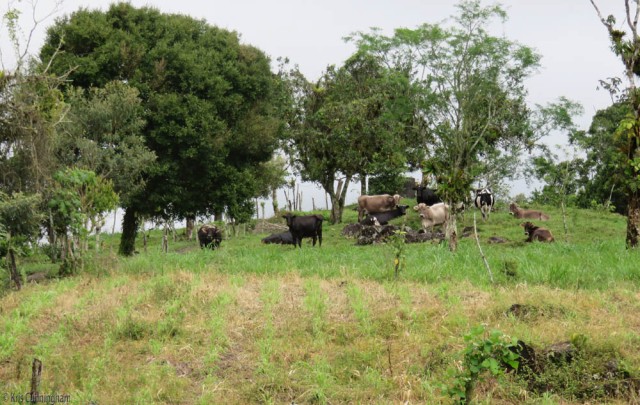
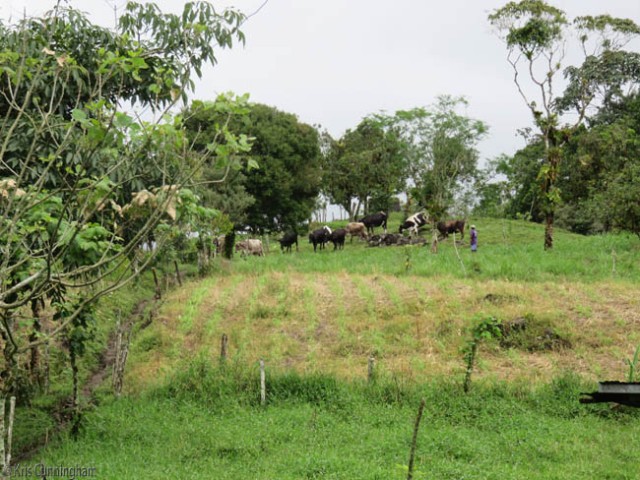
When we arrive, the cows are waiting on the hill for lunch to be served.
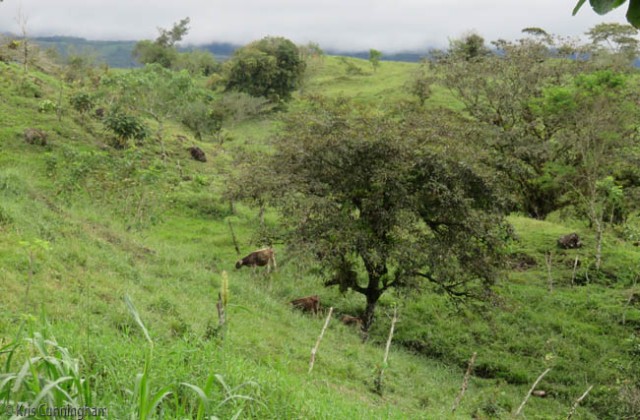
The older calves are grazing down the hill.
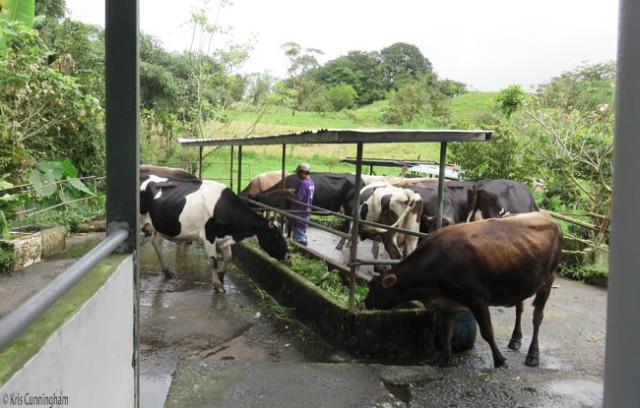
Lunch is served!
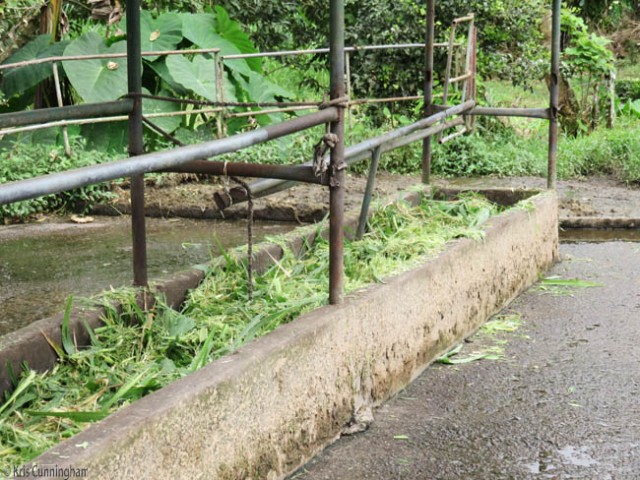
Every other day the caretaker cuts tall grass for the cows, hauls it back to the milking building, runs it through the chopper, and serves it to them for lunch and dinner. The molasses is diluted with water and sprinkled over the grass. It adds nutrition and since they like the taste, they eat better and produce more milk.
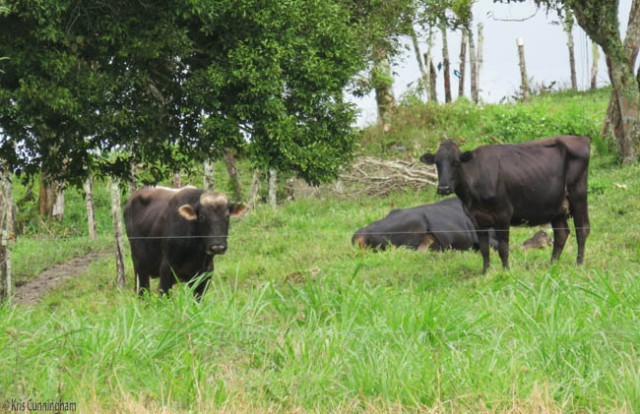
The bull gives us the evil eye.
Lunch is ready, so the caretaker goes up to bring the cows down to eat.
The bull does not like visitors. Do not touch my women. Do not look at my women. Don’t even think of being on the same farm as my women! This bull apparently has no respect for human women and respect only for a couple guys who he knows, like the caretaker. We are very careful to know where the bull is at all times, and to not go into the pasture where he is. But, to his credit, he has been doing his job and most of the cows are pregnant.
The cows start to eat while the caretaker ties the bull to the railing (behind the black and white cow on the left)
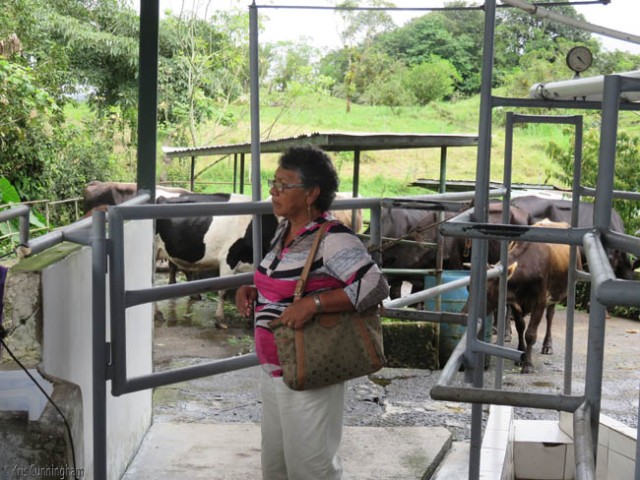
La jefe (the boss) Cedo surverys the scene
The farm also has chickens and pigs. In the past it produced vegetables for sale to restaurants, but that would take more work and manpower than is available now. It currently does produce squash, chayote, bananas, plantains, and citrus fruits though, and I am often the recipient of some very nice gifts from the farm.
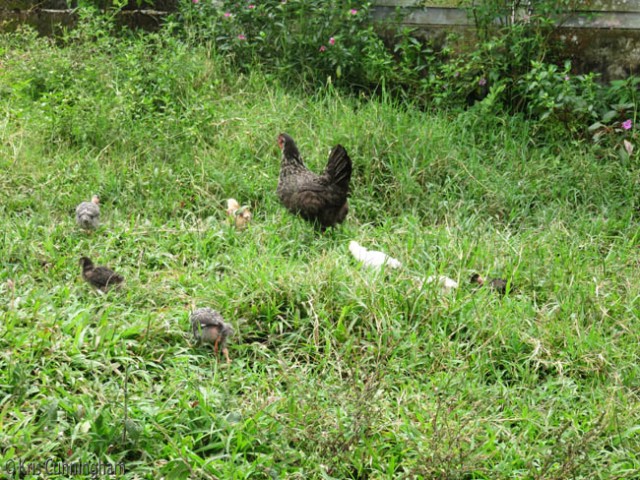
Baby chicks follow their mother around. There were also some bigger ones out exploring on their own.
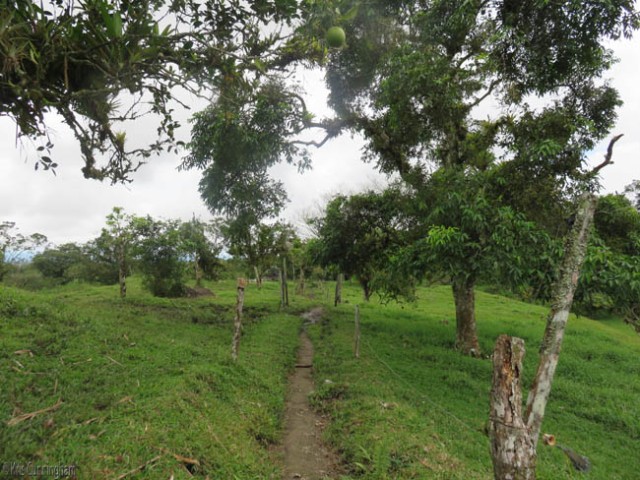
We head up the path to check on the grass which was recently planted.
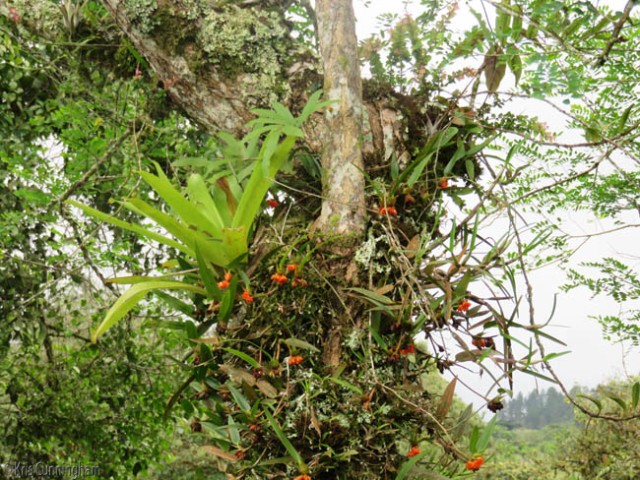
Pretty orchids grow wild in a tree.
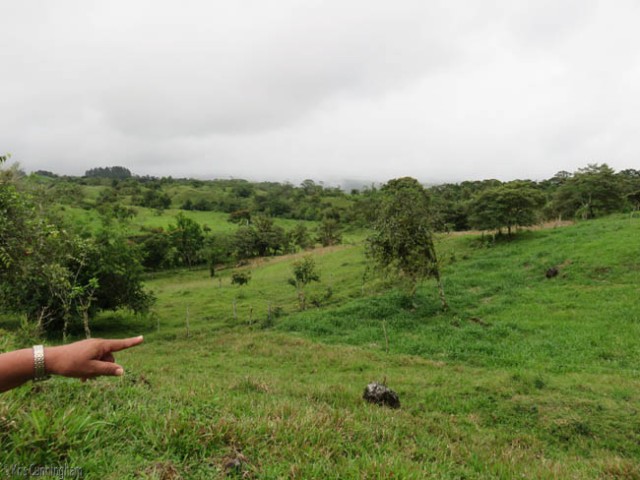
One of the pasture areas was recently planted with grass for the cows. It is a bit far from the milking and feeding area but Cedo explained that it will be included in the pasture rotation. The cows will be allowed to graze one day, some fertilizer will be applied, the grass will be allowed to grow for a few days, and then the cycle will be repeated.
The greener patch of grass that Cedo is pointing to is the newly planted grass.
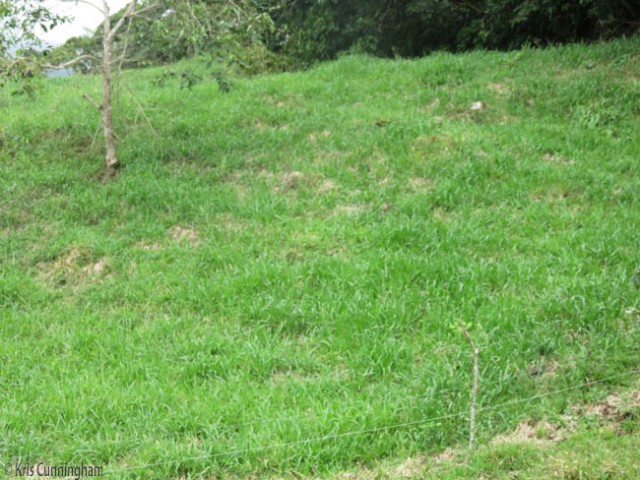
Cedo was happy that the grass looks green and healthy.
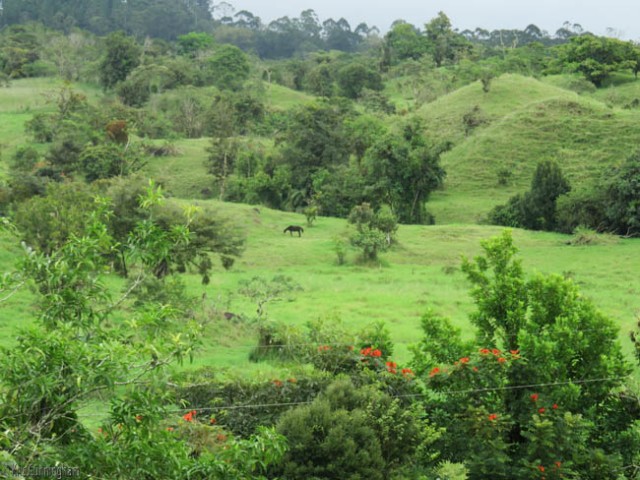
The hills beyond make a very picturesque scene.
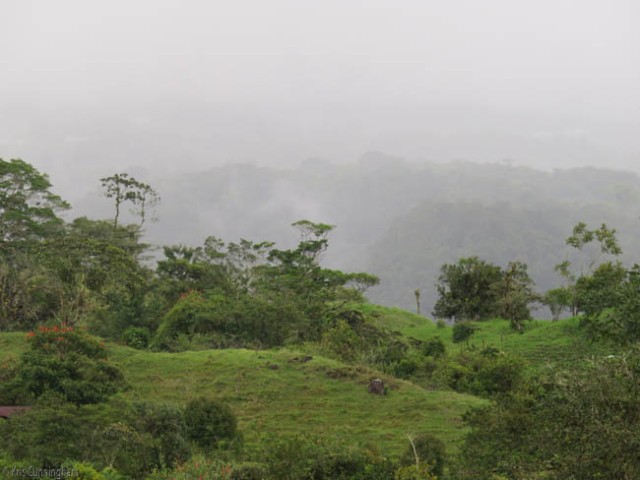
In the distance, it looks like the rain is moving in.
Cedo asked me to take some photos of the corner of the wooded area to remind her about something, maybe checking the condition of the fence?
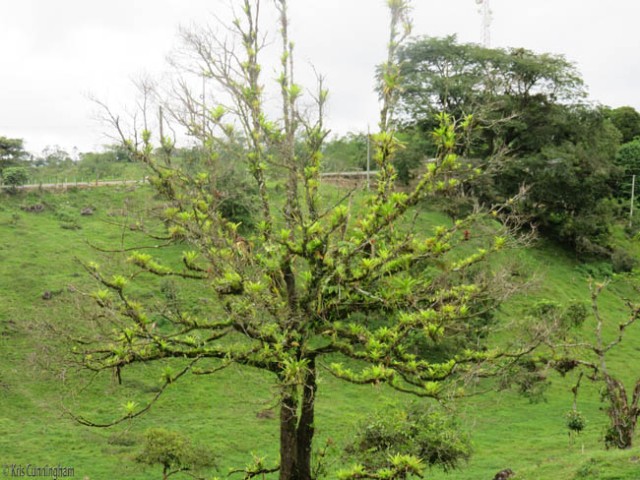
I love how so many of the trees are almost their own forests, covered with a variety of other plants.
This pretty tree caught my eye as we walked back.
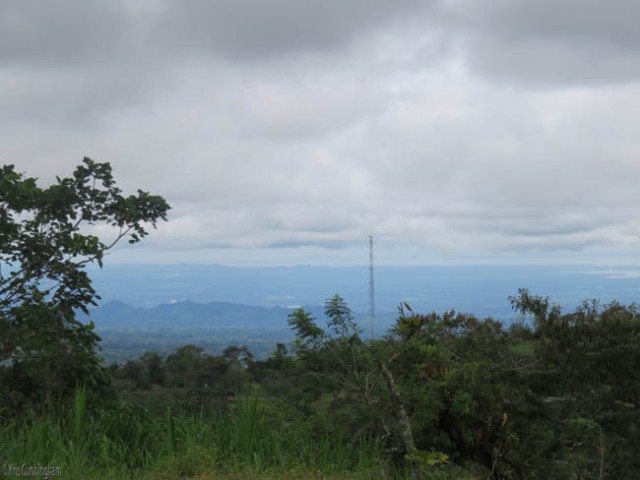
In the distance, you can see the Pacific Ocean!
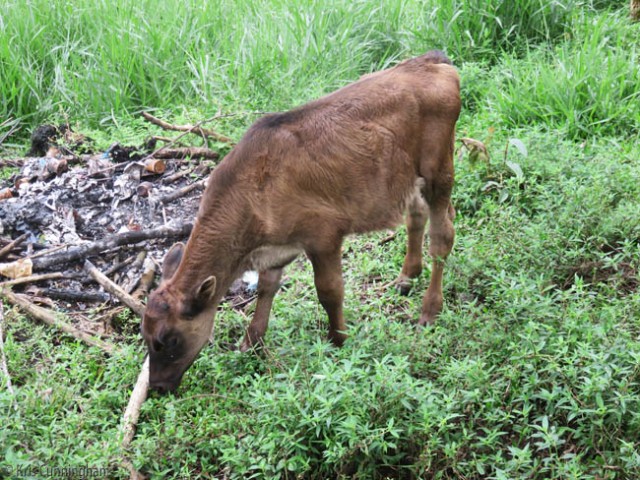
Cedo has had a lot of trouble with calves, and has lost three of the last four ones born. She got this one medicine, special food, and a very specific list of instructions for the caretaker that must be carefully followed. This calf looked like skin and bones when I saw it last, but thankfully she is thriving now and looks so much better!
Cedo says this breed of cattle never looks very plump, and she was very happy with the condition of the calf now. She certainly looked way better than when I had seen her before!
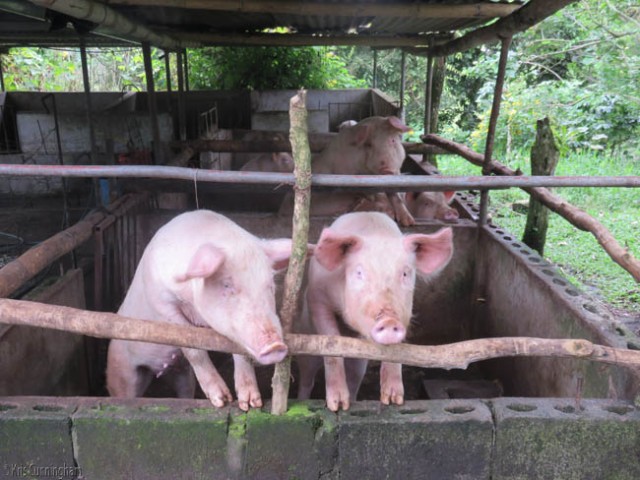
Last, but not least, we visited the pigs who were very excited to have visitors.
I don’t know much about farming and taking care of animals, but the more I learn the more I am sure I am not getting involved! It gives one new respect for where your milk, meat, and produce come from. She sells to Nevada, so when you buy milk be sure you buy Nevada and think about all the work that goes into the bottle of milk in your hand.
Día de Muertos, or Día de Difuntos is the day to remember the dead, and takes place on November 2nd. It is a quiet day with no alcohol sales, loud music, parties, or other festivities. Instead it is a day of respect, quiet reflection, and remembering loved ones. People visit cemeteries, clean the graves, and leave flowers.
I went to Cuesta Piedra the other day with my friend Cedo, and we stopped by the cemetery to visit the grave of her mother. Her mother died very young, at 36, leaving behind a large, fatherless family of 10 children. It was very hard, especially for the older children, but they all made it. Today nine of them are still living, scattered throughout the country but they all talk frequently and stay in close touch.
I snapped a few photos of the cemetery during our visit.
The Day of the Dead is celebrated Latin American countries and many countries throughout the world, though the forms of celebration may vary. Click the link for an interesting Wikipedia article about these various traditions.
Weekly Photo Challenge, Cover ArtFor this week’s Photo Challenge, stimulate your creative process and imagine which of your images you would like to see gracing the cover of a book, an album, or a magazine.
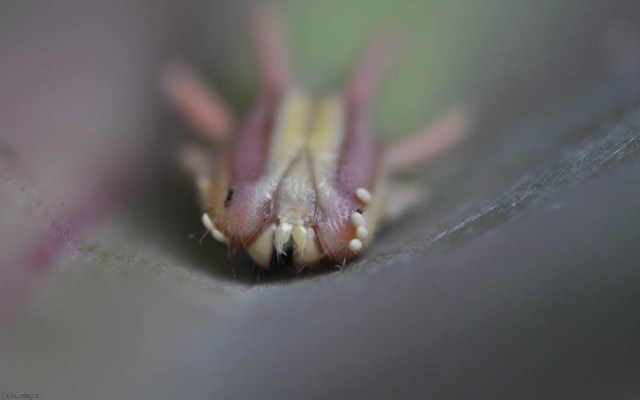
We cut down a banana tree to harvest the bananas, and found this creature under one of the leaves. If my research is correct, it is a caterpillar of the owl butterfly, a beautiful, large butterfly that we see frequently in our yard.
I think the white bits are some sort of pollen. When we discovered him the leaf had been lying in the grass, and we saw these spots on his body and the leaf as well.
Our new friend is now in a large plastic jar on the table. He apparently spend a fair amount of time last night munching on the banana leaf. This morning i gave him some new fresh leaves, and we will see how he does. If he makes a cocoon and morphs into a butterfly, that will be totally cool!
What does it cost to live in Panama? The answer can vary widely depending on where and how you live. I can tell you though what it cost us to live in David, Chiriqui, for the month of October.
Fixed expenses
Rent
$385
Cable (TV/internet)
$60.49
Car insurance, monthly (2 cars)
$50
Food
$395.63
Other
Gas for the kitchen (a can lasts at least a month)
$5.12
Electricity (it is usually around $40 but we were gone for part of the billing period)
$27.07
Gas for the cars
$65
Minutes for phone
$16.05
Medicine (the Nicaragua bug)
$14.49
Optional and/or one time expenses
Eating out
$44.03
Pricesmart membership (for a year)
$37.45
Bike repair
$14.75
Car repair
$232
Gift
$23.53
Pedicure
$10
Charitable donation
$173.50
Beer / alcohol
$98.60
The grand total is $1652.71. But, this is the first major car repair we have had in almost two years. The charitable donation is optional, of course. And, the total would also be lower if we hadn’t just gone to Pricesmart and stocked up on some food and household items, as well as enough beer/alcohol to last for quite a while.
If you subtract the car repair and charitable donation the total is $1247.21, which I think is a more realistic representation of what we usually spend in a month. Of course this is for basic living expenses. There will always be something additional like the car, travel plans, or something else.
Our biggest expenses are rent and food. We are very fortunate to have found an affordable house in a nice neighborhood of mostly professionals, business owners, teachers, and some retired people. Housing costs will vary greatly depending on where you live.
Food is another variable. We eat mostly local food and buy all our produce from the local markets. We eat very little imported and/or processed food because it is expensive and we don’t like it as well. We also never eat out unless it is a social thing with friends.
If we are home in November I’ll track our expenses again. It is interesting for us also to see what we spend and where.
just another day in the life of a retired expat in Panama….
One of my longer bike routes takes me northwest of David through the countryside and up into the hills. It is so pretty! The other day I decided to take the camera with me and share a bit of what I see.
This pretty yellow headed caracara was in front of the house. I have seen them a lot in the country but they are unusual in our neighborhood.
There is a big lot down the street which has recently been fenced in. I wasn’t sure why since nothing goes on there, but now there is a bunch of horses enjoying all the tall grass and relaxing under the trees.
As I left our neighborhood, Volcan Baru looked spectacular!
There isn’t a good way to go west along the Pan-American highway so I cross the highway and go southwest through town, and the cross back over at C Sur. This takes me by the neighborhood “La Princesa” (I’d live there just for the name), and then through the town of Aguacatal.
On the way to Aguacatal there is a huge residential neighborhood under construction.
As you go farther, the countryside is so beautiful with green fields (often with cows) and mountains in the distance. It looks like something for a travel magazine.
It is unusual to see snakes but this day I saw two in the road within a few meters of each other. This is a beautiful and harmless Mangrove Cat-eyed snake.
This is a not so harmless little coral snake. “When red touches yellow he’s a bad fellow”
What day would be complete without an interesting bug. This was running around like an ant but was a lot more interesting.
The route takes you across some very pretty rivers. This is actually a bit east of the main route but I love the chair in the water.
The route then goes through San Juan, and continues at pretty much steady climb until it intersects with 425 which comes up from San Pablo. (I know this doesn’t mean much if you aren’t familiar with the area, but if you find a Google map of the area you can find where I am)
The elementary school in San Juan. The kids will usually holler greetings if they are outside.
The route continues to go through beautiful green fields with cows, and green hills.
I like this simple little house with the saddle waiting outside.
I don’t think this little old house is being used, but it sure is picturesque.
Almost to 425 in a beautiful area, but quite far from anything, is this sign.
Just beyond the sign is this new housing area under construction.
When you reach 425 it feels like you have gotten somewhere but actually, the climbing will only increase.
I passed this guy riding his horse. They were just walking along, while I was starting to grind my way uphill. It shows how strong a horse is to not only go up, but do it with a man on his back.
This very basic house is in a pretty spot next to a small river.
I’m getting there! The tops of the hills aren’t as far up as they used to be.
One of a number of places on the route that makes cement blocks.
A turkey vulture (red head) and a black vulture on the fence posts.
After awhile 425 intersects with Ave. Joseph Halphen which not only takes you back to David, but goes mostly downhill.
Yeah, heading downhill! It is surprising how much things change in each area.
Along here there are a lot more food crops. This is yampi, a type of yam (Dioscorea trifida)
There is a lot of yucca in this area.
Some plantains are growing next to someone’s house.
There are still lots of cows too, and sometimes they come to the fence and look at me so I can take some good photos.
Another interesting and picturesque old house.
There are a few of these big trees all around the area covered with bright orange flowers.
It looks like someone has crops on this hill.
Yeah, almost home! I have yet to make it even half way up this hill though. It’s hard enough to do even on foot!
Once I get to the top of the hill, then it’s only a few minutes more to get back home.
Thanks for going riding with me! This is only a small look at the beautiful areas but I hope you enjoyed it.
We were told that scorpions tend to come in houses during the dry season because they are looking for water. We have found this to be true so far. We are now in the height of rainy season though and yesterday, when we were showering, I happened to look over at the shower curtain and there he was!
What is it about the shower curtain that they seem to like?
This is the second time we have found one near the top of the shower curtain. It was probably hiding in the folds and when we pulled the curtain closed, he was revealed. I think these are pretty cool critters, but not in the house please. Joel got it into a bucket and I tossed it over the fence into the woods where, hopefully, it will make its way somewhere else.
In the bucket, ready for its flight over the fence.
We share our environment with a lot of various critters so it’s always good to shake out clothes, shoes, towels, and anything else where something might be hiding. And, never put your bare hands in leaf piles or other likely hiding places outdoors either. These are good things to do anywhere you live, just in case.
I love living next to the woods because of all the birds and wildlife! If one gets a bit closer than I’d like, at least I can grab a camera and share a photo before it gets “relocated” over the back fence.
I think it is common knowledge that many people are going to have a hard time affording a comfortable retirement, and we all know people who plan to work until they drop because they feel they have no other choice. Joel came across an article recently – Middle-Class Americans Living With Regret About Retirement Savings One line jumped out at me
In a new survey question added this year, 22 percent said they would rather “die early” than live without enough money for a comfortable retirement.
More than one in five people are afraid they will be so poor that the time will come when life isn’t worth living. What a sad statement.
I can quote more statistics and link to more articles but I don’t think we need convincing that many people are going to retire with less than they think they need, or won’t retire at all. What does this mean in terms of quality of life?
Quality of life is much more than a financial thing, and I’m afraid that in the US we are going about it all wrong. It wasn’t until I left that I fully realized how much we are brainwashed to buy more, to have better stuff, a better job, house, spouse, car, clothes, jewelry… on and on and all this will make you happy. Work hard, get an education, get the great job, work very hard, and you too can succeed. But, succeed at what? Being happy? Not necessarily.
Then, I come to Central America and meet a lot of very happy people. Many of them live in conditions we would find totally unacceptable. There are financially poor people here in David, and even more in the more rural areas. There are terribly poor people in Nicaragua with dirt floor houses. But, if you define success as happiness they are very successful and very rich.
The Gallup Poll on happiness that came out recently that says Panama is #1! The US didn’t make the top 10. The article states “Panama had the highest scores in the world in four of the five well-being elements — purpose, social, community, and physical well-being. Sixty-one percent of Panamanians were thriving in three or more elements, the survey found.” Notice they didn’t score well in the 5th element – feeling financially secure.
What does this have to do with all of us? I’m not sure, but it is pretty clear that most of us at or near retirement aren’t going to increase our financial net worth enough to make a bit of difference. Besides working until we drop, it seems there are two things we can do though – decrease expenses and lower expectations.
Many of us are looking at other countries as a way to decrease expenses. For some of us it is working wonderfully. For others it doesn’t work, especially those who don’t love the experience but feel forced into it by finances. There are also ways to cut expenses in the US – live in a cheaper place, give up various things, etc. But, does this help if we are filled with resentment?
I think the biggest thing we can do is change expectations. Of course this is terribly difficult to do in the US where we are bombarded with expectations every day on all fronts, from TV to newspapers and other media to the attitudes of those around us. But when you think about it, we experience our world and our happiness in our heads, in our minds. If you want to change your world, change your mind (so say the Buddhist teachers). Turn off the TV. Throw away the magazines. Cultivate friends who are happy. Be grateful for what you have. Try to help others. Get outdoors and enjoy what nature provides.
I know we are very lucky to be surrounded by happy people who generally have their priorities straight. If you ask a Panamanian what is most important you will probably hear – family, friends, enjoying life. They work hard but they are less driven and more relaxed about work. There isn’t the constant striving and stress that is so familiar in the US. Days off are for enjoying family and friends and having fun. There is no stigma about lying around in a hammock, even if you don’t have money to put paint on your house.
I have learned so much from these happy people and it has made it a lot easier for me to keep my head on straight. I really feel for the people who feel trapped in the US, unable or unwilling to leave, dealing with retirement on little money, feeling forced to continue working, feeling forced to make changes they don’t want, feeling they deserve better after a lifetime of work. I hope that somehow they can manage to make some really nice lemonade from the sour lemons.
The next stop in our day with friends was Raquel’s Ark in Volcan. Raquel has a number of interesting animals and birds which she cares for and clearly loves. Most are tame and enjoy visitors so it is a great place to see some of the wildlife of Panama up close.
The first were the sloths! These gentle and slow moving animals are usually seen high in trees where they are sometimes hard to spot. I have been lucky enough to see some on the wild, but only at Raquel’s have I had the chance to touch and hold one.
They feel solid with fairly coarse fur, and hang on well until they see something or someone else they want to investigate.
I like you and want to be with you.
Or, maybe the lady with the camera looks more interesting! (this one had recently lost a tooth and there was a bit of blood coming from the gum)
The bigger one decided to climb around on the roof supports for a while.
Selfie with a sloth
There were also coatimundi, aka coati who needed attention. One in particular loved to be held.
Cuddling and taking pictures, main activities of the hour.
Holly has found a great friend!
He seemed to love all of us.
More cuddle time
happy guy
There were many more animals and birds to see!
Polly the parrot hangs out in the garden.
The coyote needed a bit of a talking to before guests could approach.
Me! me too!
The white face monkeys like to bite guests so we didn’t go in their enclosure.
The little kinkajou was woken up and taken out of his sleeping box.
Raquel told us that this kinkajou has traveled and worked with her a lot and has appeared in commercials.
This animal is nocturnal though, and soon climbed back to the sleeping box.
This beautiful cat was hard to photograph through the fences, but we would have to go through the monkey cage to get closer.
I’m not sure the monkey was happy to be left out of all the attention.
A coatimundi was so cute cuddled in the hammock with a raccoon.
The owl is blind and has to be hand fed. There was a smaller one like it in the box too.
This other owl is really beautiful. Raquel said she has let it go but it always comes right back.
The hydroponic garden has herbs and a lot of lettuce.
The talapia tank at the other end helps feed the plants.
This is a wonderful place to visit. We enjoyed seeing all the animals and birds, and it was great to talk with Raquel and learn more about the place, and hear stories of all her animals and birds. Many of them cannot be released because they are unable to manage in the wild or they are too accustomed to people, but she releases those who can safely be returned to the wild.
If any of you have a chance to visit this place I highly recommend it. Admission is free but donations are gratefully accepted to help with the food and upkeep of the animals. It is located right in Volcan and here is a map to help you find it. I think it is the only two story house in the area.
I will close with a video of Raquel giving the viewers a tour. It is a couple years old before the hydroponic garden was completed, but it will give you an introduction to the place in her own words.